How we give design feedback
Readymag’s head of design shares the feedback practices used by the team.

Over time, the Readymag design team has developed a set of practices that shape how feedback is given and received. Alexander Moskovskiy, Readymag’s head of design, shares how feedback works within the team, with a focus on design feedback—discussions of the work itself rather than broader conversations about collaboration.

Preserve authorship
“When a designer completes a task, it matters to me that the result turns out well. But it’s equally important that the person doing the work is satisfied with it and feels that it’s their own,” Alexander says.
One practical outcome of this approach is giving less feedback during the process itself and instead drawing conclusions afterward. At Readymag, there’s no approval stage for smaller assets before they go into production. Instead, the work is reviewed after the fact, discussed, and used to shape recommendations for the future.
Another potential stumbling block is feedback in the form of direct edits or reworks—and here, things are less clear-cut. “Sometimes it’s difficult to give design feedback verbally,” says Alexander. “It’s much easier to simply rework something and suggest it as an option. Some people find that annoying, and so did I. But once you understand that no one’s trying to override your work or insult you, it becomes clear that this is simply a more convenient way to communicate. It’s just easier to discuss visuals with images than with words.”
During work meetings, the Readymag design team uses a shared file where everyone uploads their works in progress. Often, instead of verbally suggesting that someone move or recolor something, people simply jump in and experiment directly.
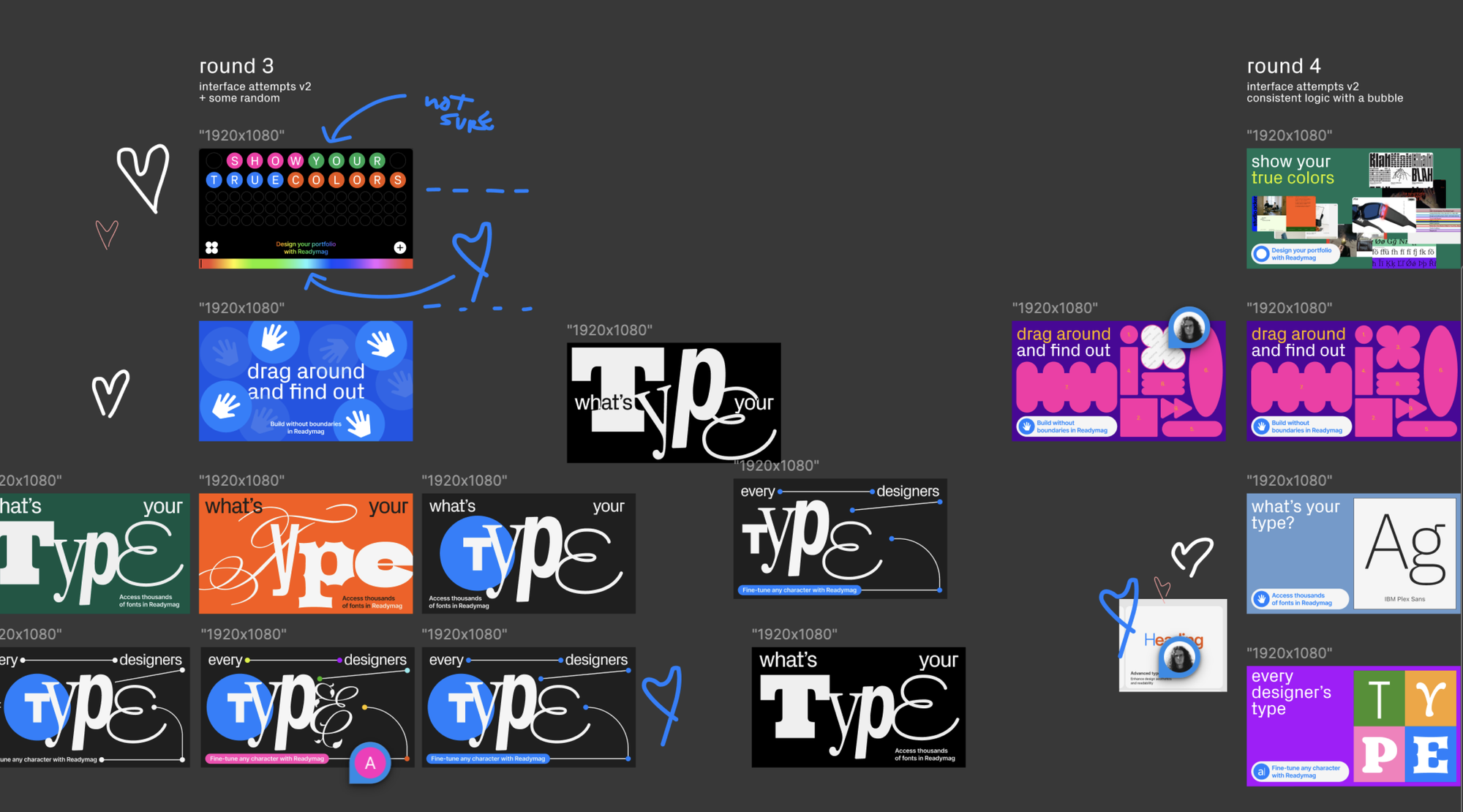
“We all have a strong feeling that moments like these are when something new and exciting emerges,” says Alexander. “But the most important thing is that it never feels like I reworked something and handed it over as final. I might rework it and suggest that a direction is worth exploring or something should be taken from it, but the task still belongs to a specific person—good feedback doesn’t take away authorship. We’re all essentially running on the serotonin of making something great—and when that feeling disappears, things get bad.”
Agree on a feedback style
“There’s the so-called ‘feedback sandwich’, where you start with a positive comment, then make a criticism, then end with another positive comment. It's the generally accepted, ‘correct’ way of giving feedback. At some point, though, the design team and I realized we preferred more direct feedback. If we don’t like something, we don’t wrap it in compliments—we say it like it is,” Alexander shares.
This approach has worked well for all of the current team members, but what happens when someone new joins? “In that case, I simply ask what communication style they prefer. Until then, I try to give feedback as gently as possible.”
Seek other perspectives
Designers work across different levels: they might focus on a specific animation in a specific image, the image as a whole, the motion system, a campaign identity, Readymag’s identity overall, or even broader shifts in the tech and design industry. To see the full picture, it’s important to understand what’s happening at every level and how it connects to everything else. But, moving between these levels is resource-intensive.
“When designers work on something, they naturally dive deep into the details. My role isn’t to go too deep, but to offer a top-down perspective. The designer brings the bottom-up perspective. Together, that creates new input for the work,” explains Alexander.
Anyone can give design feedback to anyone. Marketing designers give feedback to product designers and vice versa, and some of the most useful feedback comes from outside the design team.
“Many designers have an attitude like, ‘Why would I listen to design feedback from someone who’s not a designer? I’m the designer, I know better.’ I think that’s wrong, because you always have design bias. If you ignore outside feedback, you can become fixated on what’s beautiful and harmonious—things that don’t necessarily exist in the real world. External feedback helps bring you back down to earth,” says Alexander.
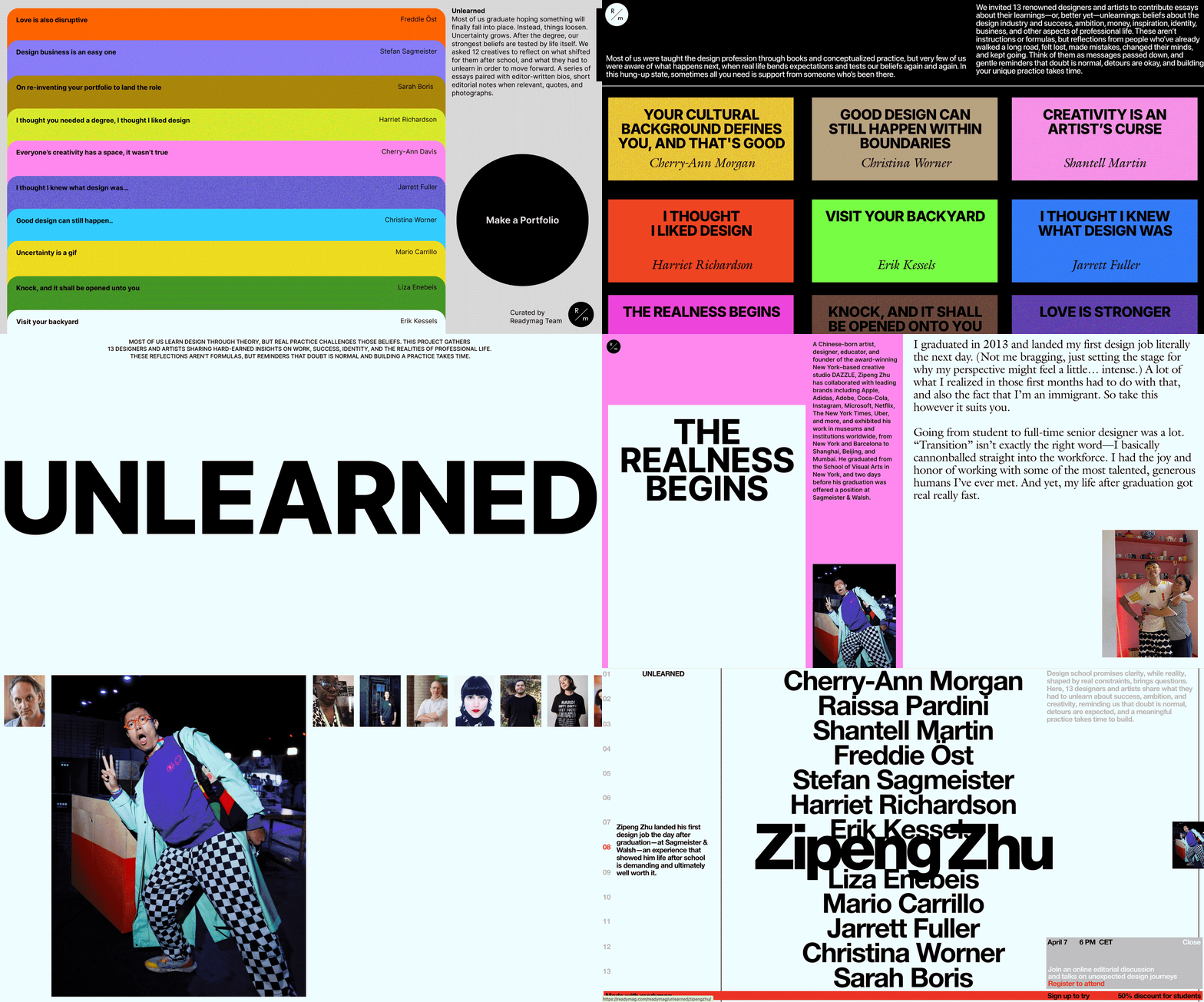
A good example is the social media cards for the recent editorial project UNLEARNED. On the project website, small quote text surrounded by a lot of white space worked well in contrast with other elements. To maintain consistency, designers applied the same approach to the social cards. But in that context, the solution no longer served the communication goal, and a member of the marketing team pointed out that the text was simply too small to work.
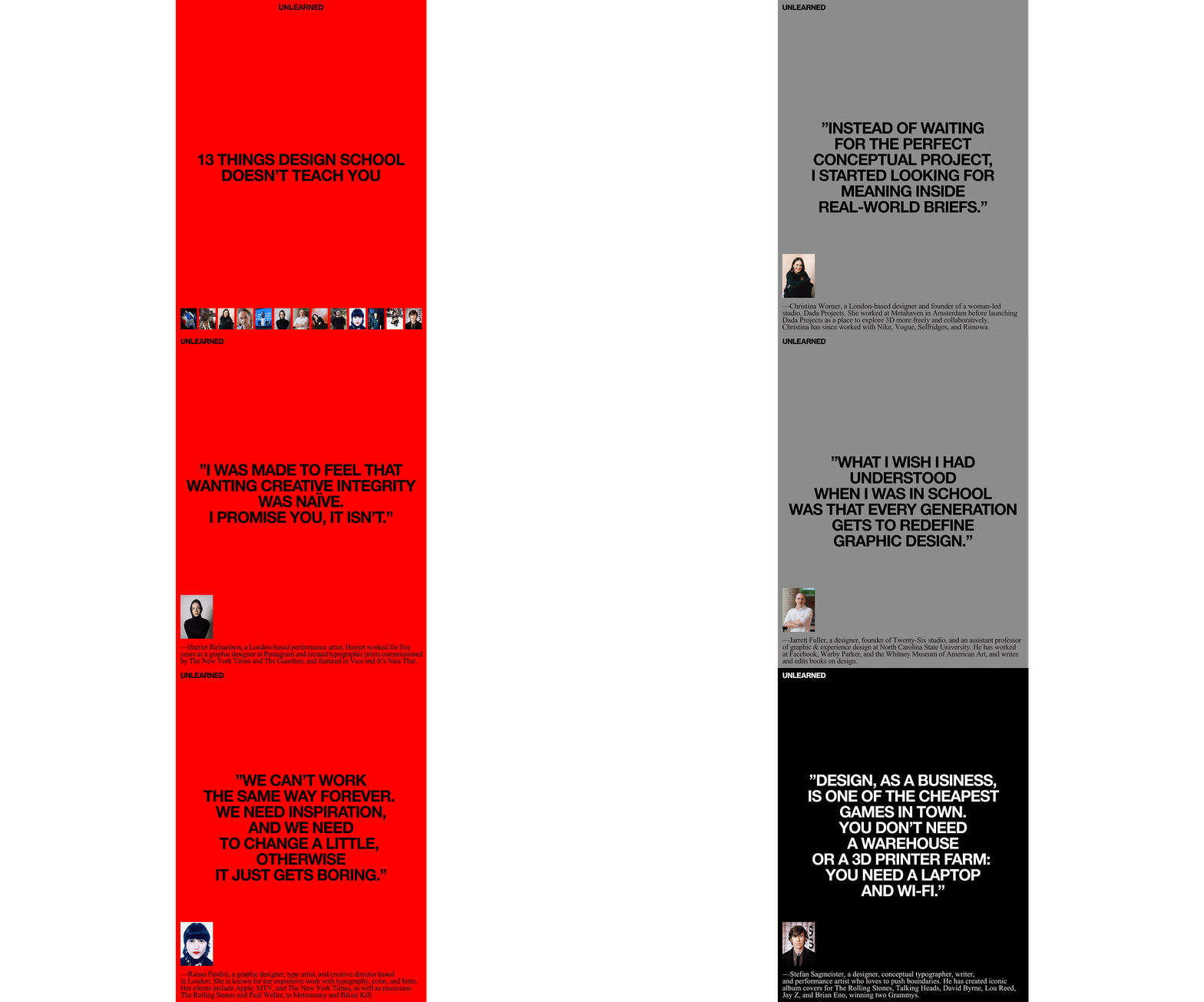
“I think the visual device overpowered the meaning and what this thing actually is: a quote. It should first and foremost work as a quote,” Alexander comments.
Create shared language
“We try to create shared concepts that help us talk about design more clearly. Over time, the team has developed a common language, a set of references and agreements that make feedback easier and more specific. Instead of relying on vague comments, people can point to ideas everyone already understands,” Alexander shares.
For example, the team uses the concept of Levels as a way of balancing consistency with experimentation: Level 1 is as close to the Readymag style as possible, Level 2 is less so, and Level 3 isn’t Readymag at all. Some projects stay closer to Level 1 to help reinforce the brand, while others move toward Level 3 to keep the work fresh and unexpected. In practice, the Levels system also acts as a framework for setting goals and giving feedback.
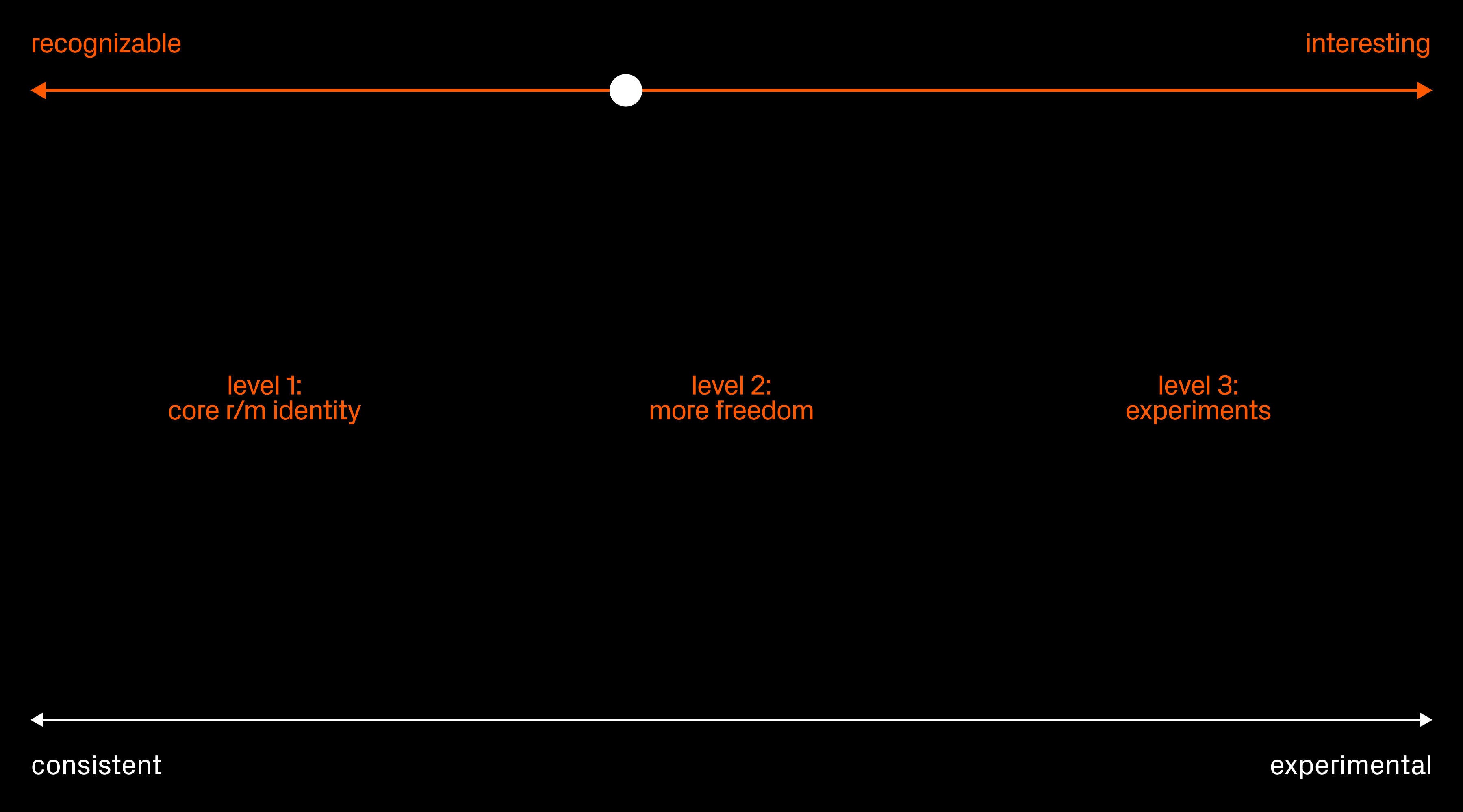
In the past, discussions often relied on subjective comments like, “This image feels too bold,” or “This feels too boring,” or “There’s not enough Readymag here.” With Levels, however, the conversation becomes more concrete: “This should be Level 1.” And if something drifts too far, the feedback might be: “This feels more like Level 3—we need to bring it closer to Level 1.”
“We have a set of core assets: fonts, colors, shapes, compositions. We can combine them in different ways—we might keep the idea, but change the font, add a color palette, or adjust the composition. Suddenly, it feels sufficiently ‘ours,’ moving it from Level 3 to Level 1,” Alexander explains. “So we create tools to discuss things we’ve already aligned on, then use those tools in communication and feedback.”
Course-correct when needed
For larger projects, timely feedback matters. One way to make it more effective is to plan clear stages for review so feedback arrives before too much work accumulates in the wrong direction. Still, even with good timing, things don’t always go as planned. “There have been times when we got pretty far, only to realize we were heading in the wrong direction,” says Alexander. Interestingly, anyone can point this out—but usually not the designer, who’s focused on the most detailed level of the work.
“I hate telling someone they need to start over—they hate realizing they’ve been grinding away for nothing. But afterward, I think we all realize it was the right decision,” Alexander admits.
That’s what happened with UNLEARNED: the team spent a long time exploring different directions before realizing something essential was missing from the nearly finished concept, and in the end, it had to be almost completely redesigned. The overall style and approach remained, but the designers still made major changes to what had seemed nearly final.